
Eight tracks. One producer’s vision. Golden Era instincts meet a new generation of beatmaking hardware.
In Hip-Hop, the equipment changes, the technology evolves, and the production possibilities continue to expand. But the instincts behind a truly distinctive beat remain rooted in something deeper: rhythm, feel, imagination, and the ability to turn a sound into something entirely your own.
With his new EP, Old School, New Machine: The MPC Sample Sessions, DJ Iceman brings that philosophy into focus, putting the spirit of classic East Coast Boom Bap alongside the contemporary possibilities of the MPC Sample.
The title says plenty. This is a project built around the relationship between two eras of beatmaking: the raw, sample-driven foundations that shaped Hip-Hop’s Golden Era and the modern hardware that gives today’s producers new ways to explore that tradition.
For DJ Iceman, a Brooklyn-born producer whose musical identity is deeply connected to the gritty aesthetics of underground Hip-Hop, the concept feels right at home. Rather than abandoning the old-school approach in favor of whatever happens to be fashionable, Old School, New Machine places the emphasis on continuity. The machine may be new, but the musical language comes from decades of Hip-Hop history.
A new machine with an old-school mindset
The MPC has occupied a special place in Hip-Hop production for generations. Its pads, sequencing workflow, and sample-based approach helped shape the sound of countless records, giving producers a hands-on way to transform fragments of existing music into entirely new compositions.
The MPC Sample Sessions concept draws on that lineage while embracing a contemporary instrument.
What makes the project’s premise compelling is the contrast between technological change and artistic consistency. New hardware can offer different workflows and fresh creative possibilities, but it cannot replace the producer’s ear. The choices that matter most still come down to what gets selected, how sounds are arranged, where the drums land, and when a beat has found its identity.
That is the creative territory suggested by Old School, New Machine. It is not simply about using a new piece of equipment. It is about bringing an established musical perspective to a new creative environment.
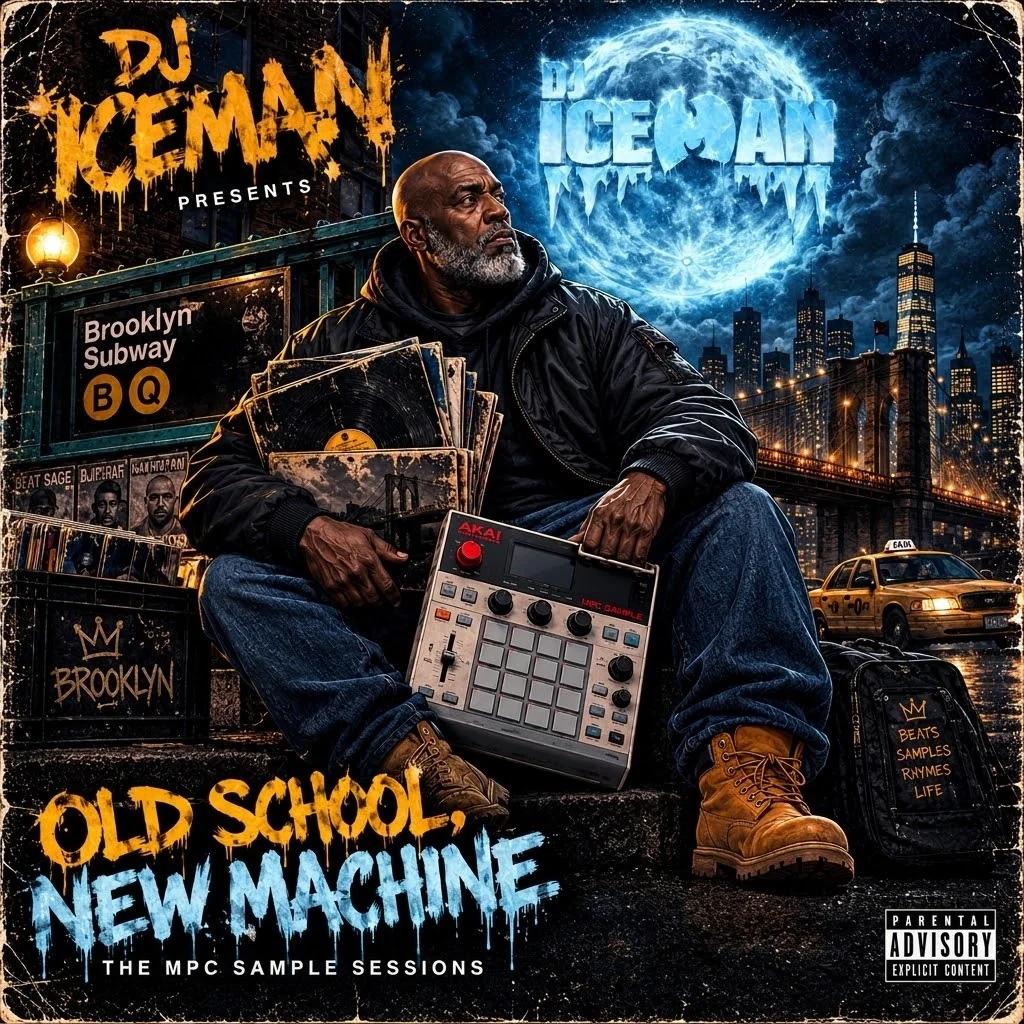
The cover artwork reinforces that idea. Against a weathered Brooklyn street scene, DJ Iceman sits surrounded by vinyl, crates, and an MPC, with the city’s skyline and a glowing blue moon behind him. Orange lettering evokes the rough-edged visual language of classic underground Hip-Hop, while the cold blue lighting gives the image a distinctly modern atmosphere.
It is a visual collision of past and present, with the producer at the center of both worlds.
Eight tracks, one creative statement
The EP features eight tracks, each contributing to the project’s identity through its title and place in the sequence.
01
Cherry Pop
The opening statement
02
Be The One Remix
A remix perspective within the project’s wider palette
03
Funky Other
A title that suggests room for a different groove
04
Warm Side
A contrasting mood within the collection
05
Super Luxury
A title with a polished, larger-than-life attitude
06
Shakey Sheik
An unconventional title in a character-driven tracklist
07
Raggey Shaolin
A name that nods toward the rugged, martial spirit of underground Hip-Hop culture
08
Murder One
A forceful title to close the sequence
The tracklist moves through a range of evocative names, from the playful suggestion of “Cherry Pop” to the more hard-edged implications of “Murder One.” “Be The One Remix” also signals that reworking material is part of the creative vocabulary represented here.
Without reducing the EP to a collection of machine demonstrations, the eight-track format gives the project a clear focus: a producer exploring his craft through a defined piece of hardware while remaining connected to the musical traditions that shaped him.
The titles alone cannot tell the listener exactly how each beat sounds, and the real verdict belongs to the music. What they do establish is a project with its own identity, rather than another anonymous collection of instrumentals.
Brooklyn roots, contemporary tools
DJ Iceman’s broader identity as a Boom Bap producer makes the project’s central idea particularly relevant. His approach is grounded in the traditions of sample-based Hip-Hop, where the character of a sound can matter just as much as its technical perfection.
That tradition values the imperfect details: the texture, the swing, the unexpected fragment, and the rhythmic decisions that give a beat its personality. The objective is not simply to make a pattern fit a grid. It is to make the pattern feel alive.
A contemporary sampler can become part of that process without changing its underlying purpose. In that sense, Old School, New Machine speaks to more than a specific piece of equipment. It reflects a broader reality of Hip-Hop production: the tools continue to change, but creative identity is built through the decisions made with them.
The project’s artwork captures that relationship with particular clarity. Brooklyn is not merely a backdrop. The subway signage, vinyl crates, street-level textures, and urban skyline place the producer within a visual language associated with the music’s roots. The MPC sits in the foreground as the bridge between that history and the present.
The result is a strong concept for an artist-led release: recognizable in its references, but centered on DJ Iceman’s own production journey.
More than a hardware showcase
There is a difference between making content about a machine and making music with one.
Old School, New Machine: The MPC Sample Sessions is positioned as a musical project first. The hardware provides the framework, but the finished beats are the reason to listen. That distinction matters because producers can become so focused on specifications, features, and workflow that the music itself gets pushed into the background.
The stronger statement is to let the results speak.
For listeners who appreciate sample-based production, the EP offers an invitation to hear what DJ Iceman brings to a new setup. For fellow beatmakers, it represents a familiar creative challenge: how do you make modern tools serve a sound that has already stood the test of time?
And for listeners who simply want instrumentals with a defined artistic identity, the title and visual presentation establish a clear expectation. This is a project built around the intersection of old-school Hip-Hop sensibilities and contemporary beatmaking.
Final thoughts: the old school never left
Old School, New Machine: The MPC Sample Sessions arrives with a clear creative premise and a visual identity that communicates it immediately. DJ Iceman places himself between Brooklyn’s Hip-Hop heritage and the possibilities of modern production hardware, using an eight-track EP to frame that relationship.
The most interesting question raised by the project is not whether a new machine can reproduce an old sound. It is what an experienced producer can do when familiar instincts meet a different set of tools.
That is where the title finds its meaning. The machine is new. The approach has history. The music brings them together.
For DJ Iceman, the mission remains rooted in the craft: make beats, preserve the spirit of sample-based Hip-Hop, and keep moving forward without abandoning the foundation.
Old school in its instincts. New machine in its hands. DJ Iceman in the driver’s seat.
Check Out The Full Release On DJ Iceman’s Website
Add comment