Mickey Factz From Bronx Roots To Cultural Academics
Coach Da God – “This isn’t a promo interview. This is an oral history, a masterclass, and a legacy conversation. Today on The Legend Series, we’re sitting with an elite MC whose pen has stood the test of time and whose vision now stretches far beyond music. From the Bronx to the booth, from albums to academia, this is the full story of Mickey Factz.”
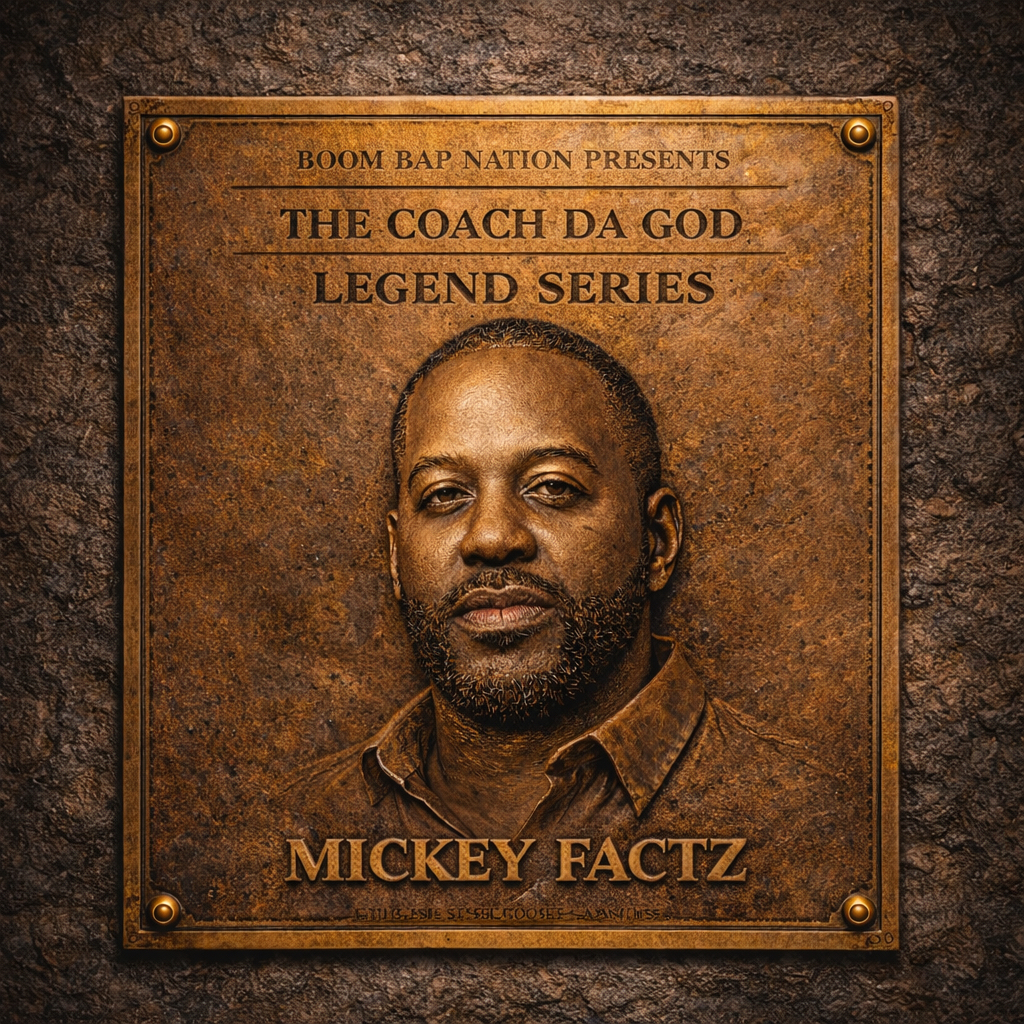
BOOM BAP NATION PRESENTS
THE COACH DA GOD LEGEND SERIES
MICKEY FACTZ
Part I: From Bronx Roots to the Birth of Mickey Factz
⸻
INTRO
Before the catalog. Before the concepts. Before the battles, the lectures, and the cultural architecture…
There was a kid moving between Harlem and the Bronx, standing at the intersection of discipline and environment, absorbing everything.
Some artists stumble into greatness. Others grow into it. Mickey Factz built his.
What makes his story different is not just where he’s from it’s how he processed where he’s from. While most narratives lean on struggle alone, Mickey’s foundation was duality: academics and street awareness, structure and exposure, gospel and hip hop, discipline and freedom.
That balance didn’t just shape the man. It shaped the pen.
In Part I of this 3 part Legend Series, we step into the origin story where the mindset was formed, where the craft began, and where Mickey Factz was first created, not just named.
⸻
CHAPTER 1: BRONX ROOTS
Coach Da God: Let’s start at the very beginning. What was life like growing up in the Bronx?
Mickey Factz: I was actually born in Harlem, so my first years were there. Then around 8 or 9 years old, I moved to the Bronx, and that’s really where I grew up and developed. I went to PS 100, then IS 131, and later Stevenson High School.
I was a smart kid I was on the honor roll, I won spelling bees, I was involved in science competitions but I also loved being outside with my friends. I was listening to hip hop heavy too. That was really my life school, friends, and music.
The Bronx shaped me socially. I wasn’t in gangs, but I was around crews. I understood the environment. I had glasses, so people would joke on me a little, but I still earned respect because I could rhyme and I was intelligent. That combination carried weight.
My parents also kept structure around me. I had a curfew. There were expectations. My father and mother did the best they could to guide me. So growing up in the Bronx for me was a mix of discipline, academics, and being outside in the culture at the same time.
⸻
Coach Da God: What did your household sound like music, conversations, values?
Mickey Factz: The house had two main sounds: gospel and hip hop. My mother played a lot of gospel John P. Kee, Kirk Franklin real 90s gospel. That music had feeling, spirit, and message. John P. Kee is actually one of my favorite artists ever.
My father played hip hop, so I was getting both sides at once. That balance stuck with me because I wasn’t just hearing rhythm I was hearing emotion too.
As far as values, my father was big on discipline. If I did good in school, I got rewarded. If I handled my responsibilities, I got rewarded. But he also taught me responsibility in a real way. When I got my first job as a paperboy, I had to pay rent. If I made $40, I had to give him $10.
That might sound small, but that taught me something major it taught me that if you’re part of something, you contribute. You don’t just exist.
The main values in the house were simple: Handle what you say you’re going to handle. Take care of your responsibilities. Stand on your word.
⸻
Coach Da God: How did your environment shape your worldview—not just your bars?
Mickey Factz: I grew up surrounded by projects Soundview, Castle Hill, Bronxdale, Monroe so every time I stepped outside, I saw the realities of the hood. That was normal for me.
But inside my house, it was different. We had structure. We had certain comforts. My father wasn’t spoiling me, but there was stability. So I got to see both sides of life early.
That shaped how I think. I wasn’t just seeing struggle I was seeing contrast. I was seeing what life looks like from different angles.
That’s why my music leans more toward life lessons than just hardship. I’m not only talking about pain I’m talking about perspective, decisions, and understanding what’s in front of you.
⸻
CHAPTER 2: DISCOVERING HIP HOP
Coach Da God: When did hip hop first feel like identity instead of entertainment?
Mickey Factz: I’d say around 1997 or 1998, when I started writing my own rhymes. Before that, I was reciting other people’s lyrics like most kids do.
But once I started writing, everything changed. It became an outlet. It became a way for me to express what I was thinking and feeling.
I was studying too studying how rhymes worked, how structure worked, what made something hit. That’s when it stopped being something I just listened to and became something I lived.
⸻
Coach Da God: What pulled you in first—lyrics, competition, storytelling, or self-expression?
Mickey Factz: Lyrics and self expression for sure. Bone Thugs really pulled me in because of how fast they were rapping. I wanted to learn how to do that.
But Big Daddy Kane was probably the biggest visual influence early on. Watching “Ain’t No Half Steppin’,” he felt like a superhero to me style, confidence, presence, everything.
That combination of lyrical skill and presence is what really drew me into hip hop.
⸻
Coach Da God: Who were the early artists that trained your ear?
Mickey Factz: Wu-Tang especially Method Man and Ol’ Dirty Bastard. Biggie, Pac, Jay-Z, Joe Budden, Redman, Mobb Deep, especially Prodigy.
Each of them brought something different, and listening to all of them helped shape how I understood rap.
⸻
Coach Da God: Did you see rap as an escape, a voice, or a responsibility?
Mickey Factz: Early on, it was escape. Then it became my voice. And now it’s a responsibility.
At first, I just wanted a way out mentally. Then I realized people were hearing me. Now I understand that what I say carries weight, so I have to approach it differently.
⸻
Coach Da God: When did lyricism become something you took seriously as a craft?
Mickey Factz: Around 2001 or 2002. That’s when I really locked in and said I want to be great at this.
I started studying deeper, understanding the mechanics, figuring out how to put words together in a way that was structured and impactful.
Once I realized I could really do this at a high level, I knew it was something I was going to pursue for life.
⸻
CHAPTER 3: BECOMING MICKEY FACTZ
Coach Da God: What does the name Mickey Factz come from?
Mickey Factz: I was in a group called Mickey and Mallory. I liked the name Mickey, but I knew I needed more.
I said to myself, “I just want to talk facts.” That became Mickey Factz. Once I added the “Z,” it felt complete.
⸻
Coach Da God: What did “Facts” represent to you?
Mickey Factz: Reality. Real life. Real experiences. I wanted to talk about what was actually going on around me.
⸻
Coach Da God: Did you grow into the name or did the name grow with you?
Mickey Factz: I grew into it. Before that, I was just rapping about whatever. Once I became Mickey Factz, I felt like I had to make the name mean something.
⸻
Coach Da God: Did you ever question the name?
Mickey Factz: Never. Once I chose it, I knew that was it.
⸻
CHAPTER 4: FIRST BARS & FIRST RECORDINGS
Coach Da God: Do you remember your first rhyme?
Mickey Factz: Yeah, I remember it. I was wilding. Big L influence, punchlines, multis just trying to be nice.
⸻
Coach Da God: What was your mindset back then?
Mickey Factz: Just trying to be dope. I wanted to stand out. I wanted people to hear me and know I could really rap.
⸻
Coach Da God: What was the first song you recorded and where?
Mickey Factz: “6 Express,” recorded in the Bronx in 1998. I was nervous, but I got it done in one take.
⸻
Coach Da God: What did hearing your voice back for the first time feel like?
Mickey Factz: It was incredible. I listened to that song for hours walking home. That feeling you don’t get that back.
⸻
Coach Da God: When did you realize your pen was different?
Mickey Factz: Around 2004 or 2005. When I started doing more conceptual work, I knew I was operating differently.
⸻
CHAPTER 5: SHARPENING THE CRAFT
Coach Da God: How did you develop your writing technically?
Mickey Factz: Study. I broke down what great lyricists were doing, understood the structure, and rebuilt it in my own way.
⸻
Coach Da God: How important was freestyling?
Mickey Factz: Very important. I trained with it like a muscle. It sharpened my mind and helped me stay ready.
⸻
Coach Da God: How do you view lyricism?
Mickey Factz: Academic first, then spiritual, then athletic.
⸻
COACH DA GOD
Part I makes one thing clear:
Mickey Factz didn’t stumble into greatness he constructed it.
From Harlem to the Bronx, from gospel to hip hop, from discipline at home to observation outside, every layer of his foundation was building toward something. The pen didn’t just appear. It was studied, sharpened, and shaped over time.
What separates Mickey early on isn’t just talent it’s awareness. He understood the environment, but he didn’t get lost in it. He understood the culture, but he chose to study it. He understood the name, and then he grew into it.
This is where the legend begins.
In Part II, we move from the foundation to the work the catalog, the battles, the creative process, and the evolution of one of hip hop’s most technical minds.

Add comment