

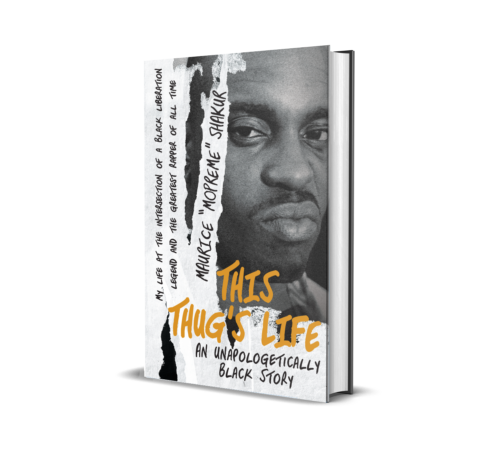
I could have spent this entire conversation asking Mopreme about Tupac. That would have been easy. Lazy, even. But that’s not what This Thug’s Life is about.
Yes, Mopreme Shakur’s story intersects with one of Hip Hop’s most historically significant eras. Yes, his family legacy reaches through both Black history and Black music history, with names like Afeni Shakur, Assata Shakur, and others carrying undeniable weight. But if you come to this book expecting recycled mythology or some sort of tell-all built around someone else’s story, you’re missing the point.
This is Mopreme’s story.
And if his own words are any indication, it’s one rooted in resilience, honesty, history, and survival.
Boom Bap Nation:
Let’s start with T.H.U.G. L.I.F.E., because folks throw that phrase around all the time without really understanding what it meant. So for the record, what did it actually stand for?
Mopreme Shakur:
“T.H.U.G. L.I.F.E. means The Hate U Give Little Infants F*s Everybody.”
And just like that, one of Hip Hop’s most misunderstood phrases snapped back into focus.
Mopreme made it clear that Thug Life was never about glorifying chaos.
“If you don’t take care of the young, the babies, they will grow up into the monsters you fear today.”
That philosophy, he explained, came from lived experience.
“We were always trying to reach the people. Pac was always trying to reach the people. We grew up around community organizers all our lives. The music was used as a vehicle, because you can’t talk to the people unless you get their attention.”
And the people they were trying to reach?
“Poor Black and Brown, disenfranchised, incarcerated, political prisoners, internationally. That’s our people. So we used Thug Life as a banner to communicate with the world.”
There was even a code.
As Mopreme described it, this was never random branding or empty symbolism. It was structured, intentional, and part of something much larger.
Boom Bap Nation:
Okay, so if folks didn’t know, now they know. Speaking of what people don’t know, what’s the biggest misconception people have had about you over the years? Did this book help clear any of that up?
Mopreme Shakur:
“I pray I’ve done it with the book.”
Then came the heart of it.
“People know me from Thug Life. People know me from Outlaw Immortals. But they don’t really know me.”
That distinction clearly matters to him.
“You shouldn’t let people box you into their perceptions of you. I see myself, I’m an artist. I do all types of music.”
Boom Bap Nation:
Reading this, what struck me is that this feels like so much more than a Hip Hop story. It’s family, movement, survival, history. Who did you most want people to understand through this book?
Mopreme Shakur:
“Everybody.”
Then he started naming names.
“My family tree is quite dense and elaborate,” he shared, referencing Afeni Shakur, Assata Shakur, Mutulu Shakur, Yaki Kadafi, Sekou, and others whose stories intersect with activism, struggle, and music history.
That broader context, he noted, is part of what makes this memoir important.
“My family crosses from Black history and Black music history in a real way. There’s no exaggeration.”
Boom Bap Nation:
You grew up in circumstances most people can’t even imagine. What was completely normal to you as a kid that the rest of us would hear and be absolutely floored by?
Mopreme Shakur:
“A parent being on FBI’s two most wanted list.”
He laughed.
“Not the average experience.”
That understatement says plenty.
“I knew nobody I knew was going through that outside of the family.”
Boom Bap Nation:
Looking at today’s Hip Hop landscape, what do you wish younger generations understood about the sacrifices some of you made?
Mopreme Shakur:
“There were a lot of sacrifices.”
The conversation turned reflective.
“Pac and I were trying to be successful for the health and welfare of our families. We barely knew what we was doing. All we knew how to do was work hard.”
Boom Bap Nation:
Can we talk about the emotional side for a second? Was there anything harder to write than the rest?
Mopreme Shakur:
“You already know.”
That landed before he even elaborated.
“That’s another reason why I feel like this book is important, because I’ve lost so many over this past 30 years. Key figures. Key people that were part of the richness of our story.”
For him, the urgency was deeply personal.
“For history’s sake, I felt it was important for me to get it down. I’m one of the last of the Mohicans closest to it.”
That line stayed with me.
Boom Bap Nation:
Did writing it help with some of that grief?
Mopreme Shakur:
“Yes.”
He explained that the urgency only grew as more people were lost.
“It became more urgent for me to get it down, get it right as possible. Losing people, losing stories that you can’t get back.”
Some of those stories, he reflected, existed only with the people who are now gone.
“So I felt it was important to get mine down. For me. And for them.”
Boom Bap Nation:
Okay, enough heavy stuff. Let’s lighten it up. You’re 10 years old, you just found five dollars, and the ice cream truck is pulling up. What are you getting?
Mopreme Shakur:
“Strawberry shortcake. Push-up pop.”
And somehow still budgeting responsibly.
“And keep the change,” he joked.
Boom Bap Nation:
Which food smells take you back to childhood?
Mopreme Shakur:
“Black-eyed peas. Grits.”
Boom Bap Nation:
Oh, I felt that one.
Boom Bap Nation:
What’s something people would be surprised to learn you’re into?
Mopreme Shakur:
“Sushi.”
That one genuinely made me laugh.
“I get down on some sushi, some sashimi,” he added, crediting his wife for expanding his tastes.
Boom Bap Nation:
One story in the book that’s going to make readers stop in their tracks?
Mopreme Shakur:
“The Madonna part.”
I immediately laughed.
“Oh my God,” I told him. “I did not think you were going to say that.”
And honestly?
Same.
There’s a temptation, when talking to someone connected to one of Hip Hop’s most mythologized eras, to chase the obvious questions.
The easy ones.
The headlines everybody expects.
But This Thug’s Life is better than that.
Because if you’re looking for gossip, you’ll miss the humanity.
If you’re looking for mythology, you’ll miss the message.
And if you’re buying this expecting a Tupac tell-all?
Like I told Mopreme directly: you’re wasting your time.
This isn’t that.
What it is, however, is a thoughtful, deeply human story from a man finally telling stories of his own, on his own terms.
Editor’s Note: Want to read This Thug’s Life for yourself? Grab your copy here.
Add comment